
Home » 12 Step Programs » 12-Step Worksheet with Questions – A Guide to Working the 12 Steps » Step 10 Worksheet With Questions – Your Daily Inventory Guide
Step 10 Worksheet With Questions - Your Daily Inventory Guide
A guided 10th step worksheet for AA, NA, Al-Anon and every other 12 step program
Steps 4 through 9 clean up the past. Step 10 keeps a new mess from piling up. This Step 10 worksheet gives you a simple way to take inventory in the moment, at the end of each day and every so often, so small problems get handled while they’re still small.
Download the Free Full Step 10 Worksheet (PDF and Word)
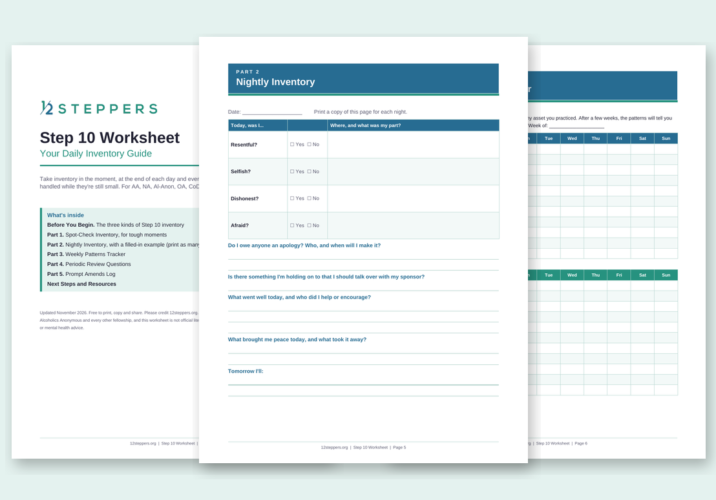
The worksheet covers all three kinds of Step 10 inventory. It includes a spot-check page for tough moments, a nightly inventory page you can print again and again, a weekly patterns tracker, periodic review questions and a log for amends you make along the way.
Print the PDF if you like working with a pen. The Word version lets you type your nightly inventory and keep it private on your own device.
Download Only the 1-Page Nightly Inventory (PDF and Word)
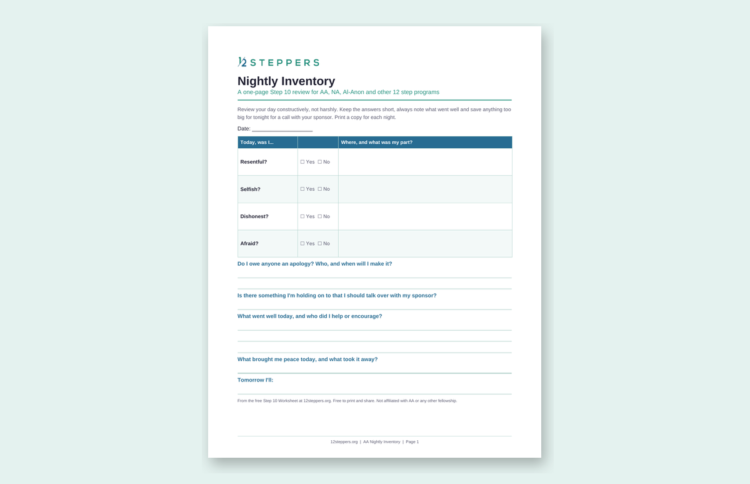
Only need the nightly review? This single page walks you through the end-of-day inventory from page 86 of the Big Book. It asks whether you were resentful, selfish, dishonest or afraid, who you owe an apology, what went well and what you’ll do differently tomorrow.
Print a fresh copy each night and keep it by your bed, or type into the Word version and save it privately on your own device.
Step 10: "Continued to take personal inventory and when we were wrong promptly admitted it."
What Step 10 Asks of You
Step 10 has two halves. The first is to keep looking at yourself honestly. The second is to own it quickly when you get something wrong, instead of letting it fester. The Big Book puts the job simply: “Continue to watch for selfishness, dishonesty, resentment, and fear” (Alcoholics Anonymous, p. 84).
If those four words sound familiar, they should. They’re the same patterns you uncovered in your 4th step inventory. The difference is timing. Step 4 looked back over years. Step 10 looks at today.
Many people call Steps 10, 11 and 12 the maintenance steps. For a deeper look at why this step matters, read our guide to Step 10 and personal inventory.
Three Kinds of Step 10 Inventory
The Twelve Steps and Twelve Traditions describes a “spot-check inventory, taken at any time of the day,” a review “at day’s end” and the “annual or semiannual housecleanings” many members do (Step Ten, p. 89). Each one has its own job.
| Inventory | When | How long | What it’s for |
| Spot-check | Any time something knocks you off balance | A minute or two | Catching a reaction before it turns into words or actions you’ll regret |
| Nightly review | Before bed | A few minutes | Looking over the whole day (the good and the bad) and noting anything to set right tomorrow |
| Periodic review | Monthly, quarterly or on a sobriety anniversary | An hour or more, often with your sponsor | Spotting patterns over time, checking for complacency and clearing anything that’s built up |
You don’t need all three on day one. Most people start with the nightly review, add the spot-check once the habit sticks and schedule a periodic review with their sponsor.
Step 10 Questions
These questions are built into the worksheet, with room to write. Several were refined from the original version of this worksheet, so long-time users will recognize them.
Spot-check questions
- What just happened, and what am I feeling right now?
- Am I hungry, angry, lonely or tired?
- What’s my part in this, even if it’s small?
- What would I do right now if I were acting on my values instead of my mood?
- Do I need to admit I was wrong, or simply stay quiet for now?
Nightly inventory questions
- Was I resentful, selfish, dishonest or afraid today? Where, and what was my part?
- Do I owe anyone an apology? When will I make it?
- Is there something I’m holding on to that I should talk over with my sponsor?
- What went well today, and who did I help or encourage?
- What brought me peace today, and what took it away? What can I learn from that?
- What will I do differently tomorrow?
Periodic review questions
- How am I making time for reflection each day? What gets in the way?
- Which defects keep showing up on my nightly inventories? What does that pattern tell me?
- Are there people, places or old patterns that put my recovery at risk? How am I guarding against them?
- Am I still working my program as hard as I was a year ago, or have I started coasting?
- What does a balanced life look like for me now, and where is it slipping?
- What did making amends teach me that I can use every day?
The Spot-Check Inventory – What to Do in the Moment
The spot-check is Step 10 in real time. It starts with an idea the 12&12 calls a spiritual axiom: “every time we are disturbed, no matter what the cause, there is something wrong with us” (Step Ten, p. 90).
That doesn’t mean the other person is always right. It means your peace of mind is your responsibility, and you can only change your own reaction.
Here’s a simple way to do it:
Pause. Before you reply, send the text or slam the door, stop. The 12&12 says it plainly: “Nothing pays off like restraint of tongue and pen” (p. 91). Waiting even a few minutes can save a relationship.
Check your body. Ask whether you’re hungry, angry, lonely or tired. This familiar recovery check, often shortened to HALT, explains a surprising number of bad moments.
Find your part. What did you expect, demand or fear? Which defect is showing up right now? Our list of character defects and their opposites can help you name it, and the opposite asset tells you what to try instead.
Act on it. If you were wrong, say so soon. If you need to cool down, take a walk, pray or call someone in the program. Then let it go and get back to your day.
The Nightly Inventory (With an Example)
The Big Book describes the nightly review this way: “When we retire at night, we constructively review our day” (p. 86). It then lists a handful of questions, which the nightly section of the worksheet covers. The word to notice is constructively.
The same passage warns against drifting “into worry, remorse or morbid reflection.” The 12&12 describes casting up “a balance sheet, crediting ourselves with things well done” (Step Ten, p. 89). A nightly inventory that only lists failures turns into a punishment, and most people quit it within weeks. Always write down what went right, too.
Here’s what one fictional night’s inventory might look like:
| Nightly question | My answer |
| Resentful? | Yes. A coworker took credit for my idea in a meeting. My part: I stewed about it all afternoon and snapped at my partner at dinner. |
| Selfish? | Took the last of the coffee and didn’t make more. |
| Dishonest? | Told my boss the report was almost done. I hadn’t started it. |
| Afraid? | Worried about money. Avoided opening the bank app instead of looking at it. |
| Do I owe an apology? | My partner, for snapping. Apologized before bed. My boss: I’ll give an honest status tomorrow. |
| Kept something to myself? | Had a strong urge to drink on the drive home. I’ll tell my sponsor tomorrow. |
| What I did well | Went to my home group. Called a newcomer to check in. Took a walk at lunch instead of stewing more. |
| Tomorrow I’ll | Tell my boss the truth about the report, open the bank app and call my sponsor. |
Notice how short the answers are. The point isn’t to write an essay. It’s to catch the day’s loose ends before they turn into tomorrow’s resentments.
Promptly Admitting When You’re Wrong
The second half of the step is just as important as the inventory. The Big Book says that when these defects show up, “We discuss them with someone immediately and make amends quickly if we have harmed anyone” (p. 84).
Prompt amends are usually short. You don’t need a speech, just honesty. A few examples:
- “I was short with you this morning, and that wasn’t fair. I’m sorry.”
- “I told you the report was almost done. Honestly, I hadn’t started it. You’ll have it by Thursday.”
- “I interrupted you twice in that meeting. I’d like to hear the rest of what you were saying.”
The worksheet includes a prompt amends log so you can track what you’ve set right. If something on your nightly inventory is bigger than a quick apology, plan it the same way you did in the Step 9 worksheet, with your sponsor’s help.
Making Step 10 a Daily Habit
The Big Book describes recovery as “a daily reprieve contingent on the maintenance of our spiritual condition” (p. 85). Step 10 is a big part of that maintenance. A few habits help it stick:
Tie it to something you already do. Keep the worksheet by your bed, or do your review right after brushing your teeth. A set time beats waiting until you feel like it.
Keep it short. A few honest lines count. Some members review their day in their heads on most nights and write it out a few times a week. Ask your sponsor what works for you.
Watch the patterns. The worksheet’s weekly tracker uses the same groups as our character defects list, alongside the opposite assets. After a few weeks, you’ll see which defects keep showing up and which assets are growing. That’s useful material for Step 6 and Step 7 work, too.
Pair it with Step 11. Many people follow their nightly inventory with a few minutes of prayer or quiet reflection. Our guide to Step 11 covers that next step.
The Tenth Step Promises
Right after its Step 10 directions, the Big Book describes what members call the Tenth Step Promises. The passage opens, “And we have ceased fighting anything or anyone” (p. 84), and it goes on to include alcohol itself. It describes sanity returning and the obsession losing its pull (pp. 84 to 85).
Notice where that passage sits. It comes after the instructions to watch for selfishness, dishonesty, resentment and fear, and to set things right quickly. Many members say that’s no accident: the peace comes from doing the daily work, not from waiting for it. Read the full passage in the Big Book’s “Into Action” chapter.
Step 10 in NA, Al-Anon and Other Fellowships
This worksheet works across fellowships. Narcotics Anonymous words the step “We continued to take personal inventory and when we were wrong promptly admitted it” (NA, How It Works). Al-Anon’s Step Ten matches AA’s word for word.
In Al-Anon and other family programs, the nightly inventory often turns up control, worry and people-pleasing more than anything else. In Overeaters Anonymous, many members add a line about their food plan. Adjust the questions to fit your program and your Higher Power as you understand it, or no Higher Power language at all if that suits you better.
Step 10 Worksheet FAQs
Do I have to write my Step 10 inventory?
No. Many members review their day mentally, and AA’s literature doesn’t say Step 10 must be written. Writing helps, though, especially early on, because it’s harder to fool yourself on paper. Many people write nightly for a while, then switch to writing a few times a week once the habit is solid.
How is Step 10 different from Step 4?
Step 4 is a thorough look back over your whole life. Step 10 is a short, ongoing check on today. They use the same tools, especially looking for resentment, fear, selfishness and dishonesty, but Step 10 keeps the list from growing again.
What is the spiritual axiom in AA?
It’s a line from the 12&12’s Step Ten essay: “every time we are disturbed, no matter what the cause, there is something wrong with us” (p. 90). It doesn’t excuse other people’s behavior. It reminds us to look at our own reaction first, since that’s the only part we can change.
Is there a 10th step prayer?
There’s no single official one. Many members turn the Big Book’s Step 10 directions on page 84 into a prayer, asking for help to watch for selfishness, dishonesty, resentment and fear and to set things right quickly. Others use a simple intention instead. Use whatever wording fits your beliefs.
What is a rapid Tenth Step?
It’s an informal name some members use for a quick, in-the-moment version of the spot-check. You name what’s bothering you, find your part and decide what to do, often in under a minute. The spot-check page in the worksheet follows the same idea.
What if the same defect shows up every night?
That’s useful information, not failure. A repeating defect is exactly what Steps 6 and 7 are for. Bring the pattern to your sponsor, look up its opposite asset on the character defects list and pick one small way to practice that asset tomorrow.
How long should a nightly inventory take?
Usually a few minutes. If it’s taking much longer, you may be drifting into the “morbid reflection” the Big Book warns about. Keep the answers short, note what went well and save bigger issues for a call with your sponsor or your next periodic review.
Additional Resources
- Alcoholics Anonymous World Services. “Chapter 6: Into Action.” Alcoholics Anonymous, Fourth Edition.
- Alcoholics Anonymous World Services. “Step Ten.” Twelve Steps and Twelve Traditions.
- Alcoholics Anonymous World Services. “The Twelve Steps.” Alcoholics Anonymous.
- Narcotics Anonymous World Services. “How It Works.” Narcotics Anonymous.
- Al-Anon Family Groups. “The Twelve Steps.” Al-Anon Family Groups.
12steppers.org is an independent resource and is not affiliated with Alcoholics Anonymous, Narcotics Anonymous, Al-Anon or any other fellowship. This worksheet is a recovery tool, not medical or mental health advice.
Previous Step 10 Worksheet Version
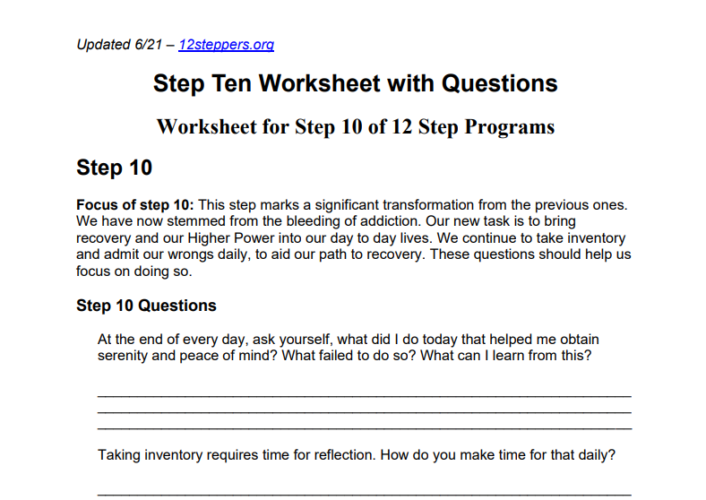
Some people and groups still prefer the original question-based format of this worksheet. You can still download the previous version below.
< Step 9 Worksheet | Step 11 Worksheet >