
Home » 12 Step Programs » 12-Step Worksheet with Questions – A Guide to Working the 12 Steps » Step 4 Worksheet with Questions – A Free Guide to Working the 4th Step » Step 4 Fear Inventory Worksheet and List of Fears
Step 4 Fear Inventory Worksheet and List of Fears
A free fear inventory for AA, NA, Al-Anon and every other 12 step program.
Download the Free Step 4 Fear Inventory Worksheet
Updated: November 2026
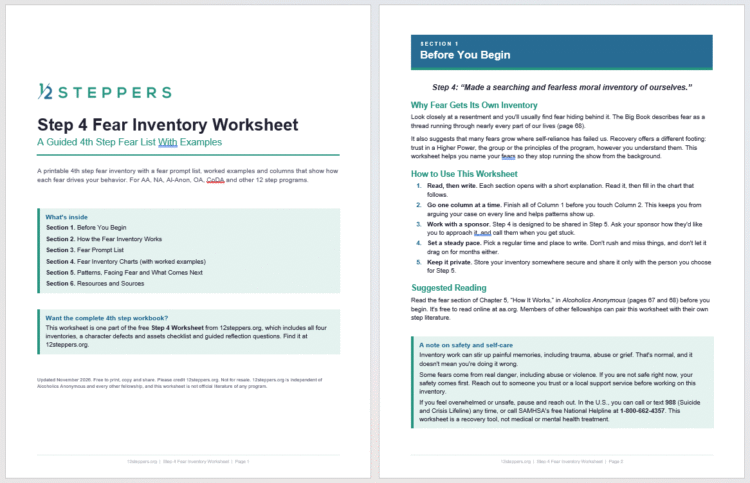
Fear rarely announces itself. It shows up as control, avoidance, a short temper or a phone you don’t answer. This free 10-page fear inventory worksheet helps you drag those fears into the light where you can actually deal with them.
It includes a fear prompt list, a five-column fear chart, two worked examples and a patterns page. Print the PDF or type into the editable Word version.
Want every Step 4 inventory in one place? Grab the free 4th step inventory workbook instead.
Step 4: "Made a searching and fearless moral inventory of ourselves."
What Is a Fear Inventory in Step 4?
A fear inventory is a written list of what you’re afraid of, why you have each fear and how it shows up in your behavior. It usually comes right after the resentment list, because fear tends to hide underneath resentment.
The Big Book describes fear as running through nearly every part of our lives (page 68). It also suggests that many fears grow where self-reliance has failed us. Recovery offers a different footing: trust in a Higher Power as you understand it, the group or the principles of the program.
Unlike the resentment chart, your fear list doesn’t need a person or event attached. If something worries you, makes you anxious or quietly steers your decisions, it belongs on the page.
How to Fill Out the Fear Chart
| Column | What to write |
| 1. I’m afraid of | Every fear you can name. Finish this whole list before moving on. |
| 2. Why? | What’s underneath the fear, where it came from and what you’re afraid will happen. |
| 3. Affects my | The parts of self the fear threatens, such as self-esteem, security, ambitions or relationships. |
| 4. Behavior | How the fear shows up in what you do, and how that behavior affects the people around you. |
| 5. Trust | What facing this fear with trust instead of control would look like. Keep it practical. |
A quick shortcut if you’ve already done your resentments: read down Column 4 of that chart and look for every “frightened” box you checked. Each one points to a fear worth listing here.
A List of Common Fears for Step 4
There’s no official AA list of fears, and yours won’t look exactly like anyone else’s. Still, certain fears show up for a lot of people working this step. Use these as prompts:
- Security: abandonment, being alone, losing a job or home, money running out, debt, illness, aging, death, legal trouble and relapse.
- Relationships: rejection, intimacy, commitment, conflict, criticism, other people’s opinions, authority figures and being controlled.
- Self and future: failure, success, not being enough, being found out, making mistakes, asking for help, change and the unknown.
- Recovery: speaking up in meetings, getting a sponsor, working the steps, doing Step 5, making amends and losing old friends.
- Body and health: pain, weight or appearance, medical news, mental health and sleep.
The worksheet’s prompt list includes all of these with checkboxes plus room to add your own.
Step 4 Fear Inventory Examples
| I’m afraid of | Why? | How it shows up | What trust would look like |
| Being alone | Growing up, I felt like I only mattered when someone needed me. | I cling to partners, text constantly and get angry when people are busy. People pull away, which feeds the fear. | Spending an evening alone without panicking. Calling a friend in the program instead of demanding attention. |
| Money running out | I’ve been broke before and lost an apartment. | I hide purchases, avoid opening bills and snap at my partner when money comes up. | Opening the mail, making a simple budget and being honest about where things stand. |
See how the fear in each example creates the very problem it’s afraid of? That loop is common, and spotting it is often the moment a fear starts to lose its grip.
Facing Fear After You Write It Down
The Big Book doesn’t ask us to stop feeling afraid. It suggests relying on a power greater than ourselves instead of our own limited strength, and asking for our fear to be removed so we can turn our attention to who we’re meant to be (page 68).
In practice, that often looks simple. Call your sponsor. Go to a meeting. Say the Third Step Prayer again. Take the next right action even when your hands are shaking. Column 5 of your chart is where you write those small, practical steps down.
Some fears come from real danger, including abuse or violence. If you aren’t safe right now, your safety comes first. Reach out to someone you trust, call or text the 988 Suicide and Crisis Lifeline or call SAMHSA’s National Helpline at 1-800-662-4357.
What Comes After Your Fear Inventory
If you haven’t written your resentments yet, start with the Step 4 resentment inventory worksheet, since the two lists feed each other. Next, many fears play out in close relationships, which is the focus of the Step 4 sex inventory.
The behaviors in your Column 4 may also point to people you’ve hurt, who belong on your harms done list. When everything is written, you’ll share it in Step 5. Our article on making a searching and fearless moral inventory covers the bigger picture.
Fear Inventory FAQs
Is there an official AA list of fears?
No. AA doesn’t publish an official list of fears. Lists you’ll find online were created by members, sponsors or treatment centers. The prompt list in this worksheet is a starting point, not a required checklist.
Do my fears have to be connected to a resentment?
No. Many fears have no resentment attached at all. If something worries you or quietly shapes your choices, list it.
Where does the Big Book talk about fear?
The fear inventory is discussed on pages 67 and 68 of the Big Book, in Chapter 5, “How It Works.” Chapter 5 is free to read online at aa.org.
What if writing about a fear makes it worse?
That can happen, especially at first. Slow down, take breaks and talk it through with your sponsor. If anxiety feels overwhelming or constant, a licensed counselor can help alongside your program.
Can I use this fear inventory in NA or other programs?
Yes. The fear inventory works in any 12 step fellowship. NA members can pair it with the NA Basic Text, and members of other programs can use their own step literature the same way.
Additional Resources
- Alcoholics Anonymous World Services. “Chapter 5: How It Works.” Alcoholics Anonymous, Fourth Edition.
- Alcoholics Anonymous World Services. “Step Four.” Twelve Steps and Twelve Traditions.
- Substance Abuse and Mental Health Services Administration. “SAMHSA’s National Helpline.” SAMHSA.
- 988 Suicide and Crisis Lifeline. “988 Lifeline.” 988 Suicide and Crisis Lifeline.