
Home » 12 Step Programs » 12-Step Worksheet with Questions – A Guide to Working the 12 Steps » Step 4 Worksheet with Questions – A Free Guide to Working the 4th Step » Step 4 Resentment Inventory Worksheet With Examples
Step 4 Resentment Inventory Worksheet With Examples
A free 4th step resentment worksheet for AA, NA, Al-Anon and every other 12 step program.
Download the Free Step 4 Resentment Worksheet
Updated: November 2026
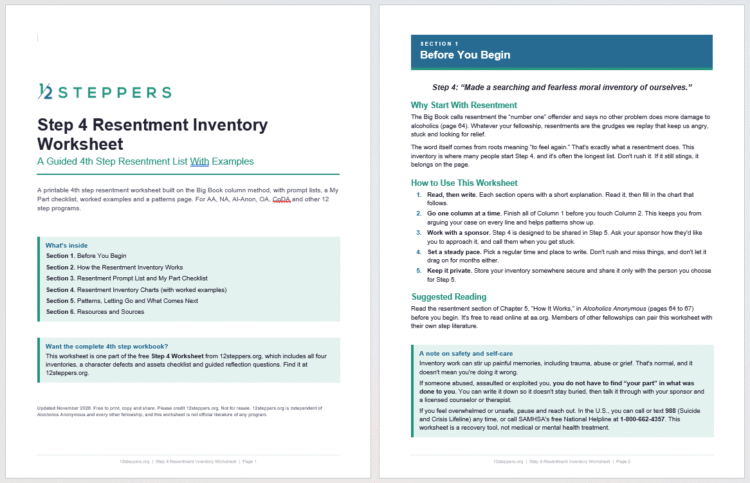
You don’t need a 33-page workbook to get started on resentments. You need the chart, a little guidance and a nudge to begin writing. That’s what this 14-page Step 4 resentment worksheet gives you.
Inside you’ll find the four-column resentment chart, a prompt list to jog your memory, a My Part checklist, three filled-in examples and a patterns page. Print the PDF to work with a pen, or download the editable Word version and type straight into the chart.
Working the whole step at once? The complete 4th step worksheet includes this inventory plus fears, sex conduct, harms and a character defects checklist.
Step 4: "Made a searching and fearless moral inventory of ourselves."
What Is a Resentment Inventory?
A resentment inventory is a written list of every person, institution or principle you’re still angry at, along with what happened and what part you played. It’s usually where Step 4 begins, and for good reason.
In Chapter 5 of the Big Book, “How It Works,” resentment is called the “number one” offender (page 64). Two pages later, the text warns that harboring deep resentment shuts us off from the “sunlight of the Spirit” (page 66).
You don’t have to be in AA for that to ring true. Whether your recovery is about alcohol, drugs, food, gambling or someone else’s addiction, old grudges have a way of quietly running the show. Writing them down is how you take that power back.
How to Fill Out the Four Columns
The Big Book’s own example on page 65 lays resentments out in three columns. A couple of pages later, it asks where we had been selfish, dishonest, self-seeking and frightened (page 67). Over the years, sponsors turned those questions into a fourth column. Here’s how each one works:
| Column | What to write |
| 1. I’m resentful at | The person, institution or principle you’re angry at. Finish this whole list before you move on. |
| 2. The cause | What actually happened, stated plainly. “She lied to me about the money” beats “She’s a liar.” |
| 3. Affects my | The parts of you that felt hurt or threatened: self-esteem, pride, emotional security, material security, ambitions, personal relations or sex relations. |
| 4. My part | Where you were selfish, dishonest, self-seeking, frightened or inconsiderate. |
One simple tip makes a big difference. Fill in all of Column 1 before you touch Column 2. Writing one full row at a time invites you to argue your case line by line. Going column by column keeps you honest and lets the patterns surface.
Step 4 Resentment Examples
A blank chart can be intimidating. Seeing a finished row makes it click. These three examples come straight from the worksheet:
| I’m resentful at | The cause | Affects my | My part |
| My sister | Didn’t invite me to Thanksgiving. Told Mom she thinks I’m still drinking. | Self-esteem, pride, emotional security, personal relations | I’d skipped the last two holidays and lied about why. I wanted her to act like nothing happened. Afraid of being judged by the family. |
| My manager | Gave the promotion to someone newer. Wrote me up for being late. | Self-esteem, pride, material security, ambitions | I was late six times in a month and blamed traffic. I expected to be rewarded for showing up. Afraid I’m falling behind. |
| The court system | Suspended my license and ordered classes after my DUI. | Pride, material security, ambitions | I chose to drive impaired and could have hurt someone. I want the consequences to disappear without changing my behavior. |
Notice that none of these entries pretend the other side was perfect. The sister may have been harsh, and the manager may have played favorites. The “my part” column simply names what belongs to the writer, which is the only part anyone can change.
Who Belongs on Your Resentment List
The Big Book describes listing people, institutions or principles we were angry with, then asking ourselves why (page 64). That three-part split is a helpful way to make sure nothing slips through.
- People: parents, siblings, partners and exes, children, friends, bosses, coworkers, neighbors, sponsors, people in the program and yourself.
- Institutions: the legal system, schools, employers, religious groups, hospitals, treatment centers, banks, the government and even 12 step fellowships.
- Principles and ideas: God or a Higher Power, religion, fairness, authority, rules, marriage and the idea of sobriety itself.
Big or small, recent or decades old, if it still stings, write it down. The worksheet’s prompt list has more than 60 starting points if you feel stuck.
Finding Your Part: The 4th Column
The 4th column is where a resentment list becomes a moral inventory. On page 67, the Big Book suggests setting the other person’s wrongs aside and looking for our own mistakes, then admitting them honestly.
That can feel unfair at first. Sometimes the other person really did hurt you. Your part might simply be that you’ve held onto it for ten years, retaliated or set yourself up to be disappointed. Many worksheets, including this one, add “inconsiderate” to the Big Book’s four words.
One important exception: if someone abused, assaulted or exploited you, you don’t have to find “your part” in what was done to you. Write it down so it doesn’t stay buried, then talk it through with your sponsor and a licensed counselor or therapist.
Letting Go: The Resentment Prayer
Writing a resentment down is one thing. Putting it down is another. The Big Book offers a practical suggestion on page 67: see the people who harmed us as spiritually sick, and show them the same tolerance, pity and patience we’d give a sick friend.
When someone offends us, we can ask how we might be helpful to them and pray to be spared from anger. Many members call this the resentment prayer or the 4th step prayer. Others lean on the Serenity Prayer or simply call their sponsor before reacting.
What Comes After Your Resentment Inventory
Read down your Column 4 when you’re done. Every box you checked under “frightened” points to a fear worth exploring in the Step 4 fear inventory worksheet. Names that involve relationships often belong in the sex conduct inventory, and people you hurt along the way belong on your harms done to others list.
Once your inventory is complete, you’ll share it in Step 5. Our guide to the importance of admitting our wrongs explains what to expect, and the Step 5 worksheet helps you prepare.
If inventory work brings up more than you can carry, pause and reach out. In the U.S., you can call or text the 988 Suicide and Crisis Lifeline any time, or call SAMHSA’s National Helpline at 1-800-662-4357.
Resentment Inventory FAQs
What is the 4th column on a resentment inventory?
The 4th column is “my part.” It asks where you were selfish, dishonest, self-seeking or frightened in each resentment, based on the questions on page 67 of the Big Book. Many worksheets also add inconsiderate.
Can I put myself on my resentment list?
Yes. Plenty of people carry real anger at themselves for past choices. The worksheet’s prompt list includes “myself” for that reason. Talk it through with your sponsor so it doesn’t turn into self-punishment.
How many resentments should I list?
There’s no right number. Some lists run a page, while others fill several. The goal is thoroughness, not a target. If it still stings, it belongs on the list.
What if the other person really was wrong?
They may well have been. The inventory doesn’t ask you to pretend otherwise. It asks you to set their part aside long enough to see your own, because that’s the only part you can change.
Can I use this resentment worksheet in NA or Al-Anon?
Absolutely. The column method works in any fellowship, including Narcotics Anonymous and Al-Anon. Use it alongside your own fellowship’s step literature and your sponsor’s guidance.
Additional Resources
- Alcoholics Anonymous World Services. “Chapter 5: How It Works.” Alcoholics Anonymous, Fourth Edition.
- Alcoholics Anonymous World Services. “Step Four.” Twelve Steps and Twelve Traditions.
- Alcoholics Anonymous World Services. “The Twelve Steps.” Alcoholics Anonymous.
- Substance Abuse and Mental Health Services Administration. “SAMHSA’s National Helpline.” SAMHSA.
- 988 Suicide and Crisis Lifeline. “988 Lifeline.” 988 Suicide and Crisis Lifeline.