
Home » 12 Step Programs » 12-Step Worksheet with Questions – A Guide to Working the 12 Steps » List of Character Defects and Their Opposites (Free Printable Checklist)
List of Character Defects and Their Opposites (Free Printable Checklist)
A complete character defects list for AA, NA, Al-Anon and every other 12 step program
Ask a newcomer to name their character defects and you’ll usually get two or three: anger, maybe selfishness, maybe “I don’t know, I’m just a mess.” Ask them again with a list in front of them and the number triples. That’s not because they got worse. It’s because a good list gives you words for things you’ve felt for years.
This list of character defects pairs 75 common defects with their opposite assets and shows what each one looks like in everyday life. Use it after your 4th step inventory, while you work Steps 6 and 7 or anytime you want an honest look at what’s driving your behavior. You can read the full list below or download the free checklist and fill it out with your sponsor.
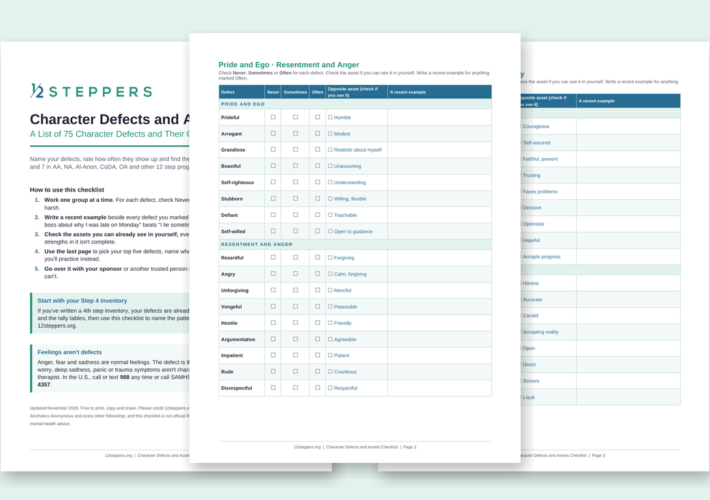
Download the Free Character Defects Checklist (PDF and Word)
Updated: November 2026
The checklist covers all 75 defects and assets on this page, grouped the same way. For each one, you’ll mark how often it shows up in your life (never, sometimes or often) and jot down a recent example. The last page helps you narrow the list to your top five and decide what to practice instead.
Print the PDF if you like working with a pen. The Word version lets you type your examples and save your answers privately on your own device.
What Are Character Defects in the 12 Steps?
Character defects are the patterns of thinking, feeling and acting that keep getting us into trouble. The Big Book describes the inventory process as searching out “the flaws in our make-up which caused our failure” (Alcoholics Anonymous, p. 64). The 12 Steps use “defects of character” in Step 6 and “shortcomings” in Step 7.
Here’s the part people miss: a defect usually isn’t a whole new trait. It’s a normal human instinct that’s been stretched out of shape. Wanting security is healthy. Hoarding money and panicking over every bill is a defect. Wanting to be liked is human. Saying yes to everything and resenting everyone is a defect.
That’s why this list pairs every defect with an opposite asset. The asset is where you’re headed, and often it’s a strength you already have in another part of your life.
One more thing worth knowing up front: there’s no single official list. The Twelve Steps and Twelve Traditions says each of us “will need to determine” our own individual character defects (Step Four, p. 48). A list is a mirror, not a verdict. You decide what fits, ideally with help from your sponsor.
The Complete List of Character Defects and Their Opposites
This character defects list is grouped into 11 families so it’s easier to work through. Many people find their defects cluster in two or three groups. Don’t rush. The “what it can look like” column is there to catch the defects that are easy to explain away.
Pride and Ego
Pride heads the 12&12’s list of the Seven Deadly Sins, and it often hides behind the others. It shows up loud (arrogance) and quiet (refusing help).
| Character defect | Opposite asset | What it can look like |
| Prideful | Humble | Won’t ask for help or admit I don’t know something |
| Arrogant | Modest | Talking down to people I decide know less than I do |
| Grandiose | Realistic about myself | Big plans and bigger promises that never get finished |
| Boastful | Unassuming | Steering every conversation back to my wins |
| Self-righteous | Understanding | Keeping score of other people’s faults while excusing mine |
| Stubborn | Willing, flexible | Digging in on a decision long after it stopped working |
| Defiant | Teachable | Bristling at every suggestion, especially from my sponsor |
| Self-willed | Open to guidance | Making the decision first and asking for advice afterward |
Resentment and Anger
The Big Book calls resentment the “number one” offender. These are the ways anger turns into a habit instead of a passing feeling.
| Character defect | Opposite asset | What it can look like |
| Resentful | Forgiving | Replaying the same old argument in my head for years |
| Angry | Calm, forgiving | Snapping at whoever is closest after a bad day |
| Unforgiving | Merciful | Refusing to let someone off the hook even after they apologize |
| Vengeful | Peaceable | Plotting the perfect comeback or quietly getting even |
| Hostile | Friendly | Walking into every room braced for a fight |
| Argumentative | Agreeable | Needing the last word, even on things that don’t matter |
| Impatient | Patient | Interrupting, tailgating and finishing other people’s sentences |
| Rude | Courteous | Ignoring messages, cutting people off, skipping the thank you |
| Disrespectful | Respectful | Mocking other people’s beliefs, boundaries or time |
Fear and Insecurity
The 12&12 names self-centered fear as the “chief activator” of our defects. Many of the defects in other groups start here.
| Character defect | Opposite asset | What it can look like |
| Fearful | Courageous | Dodging the phone call, the doctor or the honest conversation |
| Insecure | Self-assured | Fishing for reassurance and comparing myself to everyone in the room |
| Worrying | Faithful, present | Running every worst-case scenario before anything has happened |
| Suspicious | Trusting | Reading hidden motives into ordinary texts and comments |
| Avoidant | Faces problems | Leaving bills unopened and problems unspoken |
| Indecisive | Decisive | Polling five people so no choice is ever really mine |
| Pessimistic | Optimistic | Expecting the worst so I can’t be disappointed |
| Cynical | Hopeful | Writing off people, change or recovery itself as a scam |
| Perfectionistic | Accepts progress | Not starting at all unless I can do it flawlessly |
Dishonesty
Dishonesty is more than lying. It includes the stories we tell ourselves, which is why it shows up in Column 4 of nearly every inventory.
| Character defect | Opposite asset | What it can look like |
| Dishonest | Honest | Lying about where I was, what I spent or what I used |
| Exaggerating | Accurate | Inflating stories to sound more impressive or more wronged |
| Rationalizing | Candid | Building a good-sounding reason for a choice I’d already made |
| In denial | Accepting reality | Insisting “it’s not that bad” when everyone around me says it is |
| Secretive | Open | Hiding my phone, my accounts or whole parts of my life |
| Manipulative | Direct | Guilt-tripping or charming people instead of simply asking |
| Sarcastic | Sincere | Hiding real criticism inside a “joke” |
| Disloyal | Loyal | Breaking confidences or talking behind a friend’s back |
Selfishness and Self-Seeking
These are the defects the Big Book’s “selfish” and “self-seeking” checkboxes point to: putting my wants at the center and everyone else on the edges.
| Character defect | Opposite asset | What it can look like |
| Selfish | Giving | Taking the last of everything without a thought for anyone else |
| Self-seeking | Selfless | Helping only when there’s credit, approval or advantage in it |
| Self-centered | Caring | Turning other people’s news into a story about me |
| Inconsiderate | Considerate | Running late without calling and making plans without checking |
| Greedy | Generous | Always needing more money, attention or stuff |
| Entitled | Content | Expecting special treatment or acting like the rules don’t apply to me |
| Wasteful | Thrifty | Spending money, time or other people’s patience carelessly |
Self-Pity and Shame
Self-pity can look harmless, even humble. In practice it keeps us stuck, because a victim never has to change.
| Character defect | Opposite asset | What it can look like |
| Self-pitying | Grateful | “Why does this always happen to me?” |
| Complaining | Appreciative | Narrating everything that’s wrong and skipping what’s right |
| Ungrateful | Thankful | Taking people’s help and sacrifices for granted |
| Self-hating | Self-accepting | Treating every mistake as proof I’m worthless |
| Shame-driven | Self-respecting | Overworking, hiding or people-pleasing so no one sees the “real” me |
| Living in the past | Present-focused | Rehashing old regrets or old glory days instead of showing up today |
Envy and Jealousy
Envy wants what someone else has. Jealousy is afraid of losing what we’ve got. Both make it hard to enjoy anything.
| Character defect | Opposite asset | What it can look like |
| Envious | Happy for others | Feeling a sting when a friend gets good news |
| Jealous | Trusting | Checking a partner’s phone or quizzing them about where they were |
| Possessive | Secure | Getting upset when people I love spend time with others |
| Competitive | Cooperative | Turning every conversation, job or meeting into a contest |
Control and Judgment
Control often grows out of fear, and judgment keeps the focus on other people’s inventories instead of our own.
| Character defect | Opposite asset | What it can look like |
| Controlling | Lets go | Managing other people’s choices, schedules or recovery |
| Critical | Accepting | Pointing out what’s wrong with every plan, meal or person |
| Judgmental | Open-minded | Deciding who someone is after one conversation |
| Intolerant | Tolerant | Writing off people whose beliefs or lives differ from mine |
| Blaming others | Owns my part | “I only did it because you…” |
| Defensive | Open to feedback | Explaining, arguing or attacking whenever I’m corrected |
| Gossiping | Discreet, kind | Passing along other people’s business, including what’s shared in meetings |
Sloth and Irresponsibility
Sloth isn’t just laziness. It’s any way we avoid effort, follow-through or the hard parts of growing up.
| Character defect | Opposite asset | What it can look like |
| Lazy | Diligent | Doing the bare minimum at home, at work or in my program |
| Procrastinating | Prompt | Putting off the inventory, the amends or the bill until it’s a crisis |
| Irresponsible | Responsible | Leaving other people to clean up after my choices |
| Unreliable | Dependable | Saying yes and then not showing up |
| Apathetic | Invested | Shrugging off things that matter to the people I love |
| Complacent | Willing to grow | Coasting on early progress and quietly dropping meetings or step work |
| Impulsive | Thoughtful | Acting first, buying first, quitting first and thinking later |
| Reckless | Careful | Taking chances with my safety, my money or other people’s trust |
Excess and Appetite
Lust and gluttony round out the Seven Deadly Sins. Today they often show up as anything we overdo to avoid feeling something.
| Character defect | Opposite asset | What it can look like |
| Lustful | Respectful of others | Treating people as objects or using sex to escape my feelings |
| Gluttonous | Moderate | Overdoing food, shopping, screens or anything else that numbs |
| Overcommitting | Balanced | Filling every hour so I never have to sit still with myself |
Relationships and Dependency
These patterns come up often in Al-Anon, CoDA and ACA, but members of every fellowship recognize them.
| Character defect | Opposite asset | What it can look like |
| People-pleasing | Honest about my needs | Saying yes when I mean no to avoid someone’s disappointment |
| Enabling | Sets boundaries | Covering for someone, paying their way or making excuses for them |
| Dependent | Emotionally independent | Needing a partner or friend to make me feel okay |
| Isolating | Connected | Skipping calls, meetings and invitations |
| Withdrawn | Engaged | Present in the room but emotionally checked out |
| Unkind | Kind | Cold, cutting words when someone is already hurting |
Short Lists of Character Defects You’ll Hear About in Meetings
Long lists are useful, but most AA character defects lists you’ll hear quoted at meetings and in sponsorship are much shorter. Each one works as a quick self-check.
The Seven Deadly Sins
To keep things simple, the 12&12 borrows a “universally recognized list of major human failings”: pride, greed, lust, anger, gluttony, envy and sloth (Step Four, p. 48). Every group on this page traces back to at least one of the seven.
The Big Book’s four (or five)
The resentment inventory asks, “Where had we been selfish, dishonest, self-seeking and frightened?” (p. 67). The sex inventory adds “inconsiderate” (p. 69). These are the checkboxes in Column 4 of most worksheets, including the My Part column on our resentment inventory worksheet.
The 20-defect sponsorship list
A list of 20 defects, credited to a 1944 sponsorship pamphlet by early AA member Clarence Snyder, still circulates widely. It starts with resentment, fear, self-pity and self-justification and ends with gossip and greed. The AA Cleveland District Office shares the full list along with some useful history.
Feelings vs. Character Defects
Anger, fear, sadness and grief are feelings. Everybody has them, and in recovery we’re trying to feel them, not avoid them. On their own, they aren’t defects of character.
The defect is the pattern we build around the feeling. Anger that we replay for years becomes resentment. Fear that makes our decisions becomes avoidance, control or dishonesty. Hurt that we nurse becomes self-pity. A helpful question is: what did I do with the feeling?
That’s why this list uses words like “resentful,” “worrying” and “avoidant” rather than plain “angry” or “afraid.” The 12&12 makes the same point when it calls self-centered fear the “chief activator of our defects” (Step Seven, p. 76). The fear itself isn’t the problem; letting it run the show is.
One caution: constant worry, deep sadness that won’t lift, panic or trauma symptoms aren’t character defects. They can be signs of a health condition that deserves real care. If that sounds like you, talk with a doctor or a licensed therapist. SAMHSA’s free National Helpline can point you to local services.
How to Find Your Own Character Defects
The best list of character defects is the one you write from your own life. Here’s a simple way to build it.
Start with your 4th step inventory
If you’ve written a personal inventory, your defects are already on paper. Look at every check mark in the “my part” column, then at the tally tables in the Step 4 workbook. The words that keep repeating are your starting list.
Rate yourself honestly
Go through the checklist and mark each defect never, sometimes or often. Then write one recent, specific example beside every defect you marked “often.” An example keeps you honest; it’s hard to argue with what you did last Tuesday.
Ask what the defect does for you
The 12&12 admits something uncomfortable: “we exult in some of our defects” (Step Six, p. 66). Every defect pays off somehow. Control makes us feel safe. Self-pity gets us sympathy. People-pleasing avoids conflict. Naming the payoff helps you see why letting go feels hard.
Let someone else look
We’re often the last to see our own patterns. Share your list with your sponsor or another trusted person in the program. They’ll likely spot a defect you skipped and, just as often, an asset you didn’t give yourself credit for.
Count your assets too
The 12&12 notes that a good sponsor points out the newcomer’s assets alongside the liabilities (Step Four, p. 46). Check every asset you can honestly claim, even ones still under construction. An inventory with no strengths in it isn’t humble. It’s just incomplete.
Turning Character Defects Into Assets (Real-Life Examples)
Nobody wakes up one day without their defects. Change usually looks small and repetitive. These examples use fictional people, but the patterns are common in every fellowship.
People-pleasing to honest about my needs
Dana said yes to every request at work and at home, then lay awake angry at everyone. Her practice: wait a day before agreeing to anything new. Within a month, she’d turned down two requests and felt guilty for about an hour each time. That’s progress.
Impatient to patient
Marcus interrupted people at meetings and tailgated on the way home. He started small: letting one car merge in front of him every day and counting to three before answering anyone. He still slips. He also notices faster now, which is the whole point.
Self-pitying to grateful
Lena’s first thought every morning was a list of what was wrong. Her sponsor suggested a nightly list of three things that went right. Some nights the list was “I didn’t use, I ate dinner, I called someone.” It counted. A printable gratitude worksheet can make the habit easier to keep.
Controlling to letting go
Chris, an Al-Anon member, tracked his adult son’s location and called his friends to check up on him. Letting go meant deleting the tracking app and calling his own sponsor instead. His son’s choices didn’t change overnight. Chris’s sleep did.
Character Defects in Steps 6 and 7
Steps 4 and 5 help you find and admit your defects. Step 6 asks you to become “entirely ready” to have them removed, and Step 7 asks you to humbly ask for that help.
Readiness doesn’t have to be perfect. The 12&12 calls Step 6 the best possible attitude for making “a beginning on this lifetime job” (p. 65). It adds a line worth taping to the mirror: “The only urgent thing is that we make a beginning, and keep trying” (p. 68).
If you’re not ready to give up a defect yet, the Big Book offers a simple next move: “If we still cling to something we will not let go, we ask God to help us be willing” (p. 76).
The Seventh Step prayer on that same page begins, “My Creator, I am now willing that you should have all of me, good and bad.”
Your checklist becomes your working list for these steps. The Step 6 worksheet and Step 7 worksheet walk you through both. Later, Step 10’s daily personal inventory keeps an eye on the same defects one day at a time.
Character Defects FAQs
What is the difference between character defects and shortcomings?
There isn’t one. Bill W., who wrote the Steps, said in a 1963 letter, “In my mind, the meaning is identical; I guess I just used two ways of expression, rather than to repeat myself.” He used “defects of character” in Step 6 and “shortcomings” in Step 7 simply to avoid repeating the phrase (AA Cleveland).
Does AA have an official list of character defects?
No. AA’s literature doesn’t include an official checklist. The 12&12 suggests the Seven Deadly Sins as a starting point and says each person needs to determine their own individual defects. Lists like this one are tools to help you find the right words, not a required standard.
What are the Seven Deadly Sins in AA?
The 12&12’s Step Four essay names them as pride, greed, lust, anger, gluttony, envy and sloth. It calls them a “universally recognized list of major human failings” and uses them to keep the inventory simple. Many sponsors still use the seven as a first pass before moving to a longer list.
Is fear a character defect?
Fear itself is a normal feeling. What the steps target is fear that runs our lives: avoiding responsibilities, controlling people or lying to protect ourselves. The Big Book lists “frightened” in the resentment inventory for that reason. It’s asking where fear drove our behavior, not whether we ever felt afraid.
Is people-pleasing a character defect?
For many people, yes. People-pleasing often mixes dishonesty (hiding what we really want) with self-seeking (buying approval). It’s especially common in Al-Anon, CoDA and ACA. The opposite asset is being honest about your needs, which usually starts with a few small, uncomfortable “no” answers.
How many character defects are there?
There’s no fixed number. This page lists 75, the 12&12 starts with seven and online lists run to nearly 200. What matters is your own list. Most sponsors suggest focusing on the handful of defects causing the most trouble today rather than trying to fix everything at once.
Do NA and Al-Anon use the same character defects?
Yes. Narcotics Anonymous and Al-Anon use nearly the same wording for Steps 6 and 7, so this list works across fellowships. In Al-Anon, the focus stays on your own reactions and choices rather than the drinker’s or user’s behavior.
Can character defects really be removed?
Many members say their defects lose their grip over time, though few claim they vanish. The 12&12 says we shouldn’t expect them to be lifted the way the drive to drink often was (Step Six, p. 65). The goal is progress: noticing sooner, acting differently more often.
Additional Resources
- Alcoholics Anonymous World Services. “Chapter 5: How It Works.” Alcoholics Anonymous, Fourth Edition.
- Alcoholics Anonymous World Services. “Chapter 6: Into Action.” Alcoholics Anonymous, Fourth Edition.
- Alcoholics Anonymous World Services. “Step Four.” Twelve Steps and Twelve Traditions.
- Alcoholics Anonymous World Services. “Step Six.” Twelve Steps and Twelve Traditions.
- Alcoholics Anonymous World Services. “Step Seven.” Twelve Steps and Twelve Traditions.
- Alcoholics Anonymous World Services. “The Twelve Steps.” Alcoholics Anonymous.
- Narcotics Anonymous World Services. “How It Works.” Narcotics Anonymous.
- Al-Anon Family Groups. “The Twelve Steps.” Al-Anon Family Groups.
- Alcoholics Anonymous Cleveland District Office. “Defects of Character.” AA Cleveland.
- Substance Abuse and Mental Health Services Administration. “SAMHSA’s National Helpline.” SAMHSA.
12steppers.org is an independent resource and is not affiliated with Alcoholics Anonymous, Narcotics Anonymous, Al-Anon or any other fellowship. This list is a recovery tool, not medical or mental health advice.