
Home » 12 Step Programs » 12-Step Worksheet with Questions – A Guide to Working the 12 Steps » 90 Meetings in 90 Days Tracker – What 90 in 90 Means and How to Do It
90 Meetings in 90 Days Tracker - What 90 in 90 Means and How to Do It
A free printable tracker for AA, NA and other 12 step newcomers
If you’re new to recovery, someone has probably told you to “do 90 in 90.” This page explains what that means, why so many people suggest it and how to make it work with a real life.
You’ll also find a free 90 meetings in 90 days tracker to print or fill in on your computer, plus a 30 in 30 log if you’d rather start smaller.
Updated: November 2026
Download the Free 90 Meetings in 90 Days Tracker (PDF and Word)
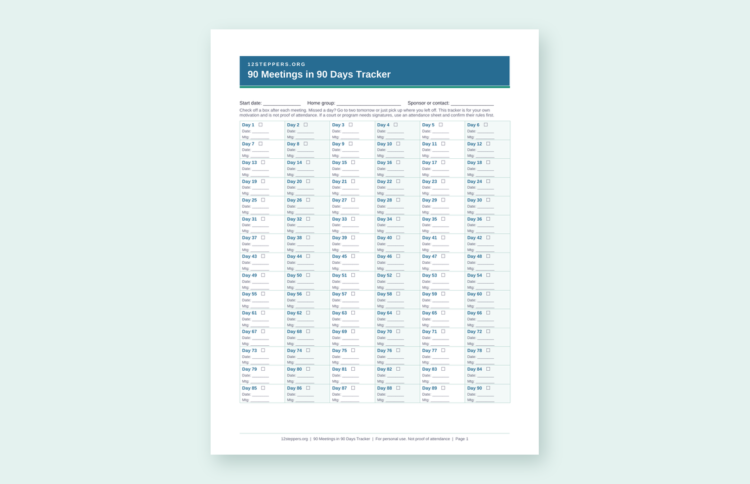
This 90 in 90 tracker fits on one organized, printable page. It has a box for each of the 90 days with room to write the date and the meeting. That will help you see your progress at a glance and keep going on the hard days.
Not Ready for 90 in 90? Start With 30 in 30
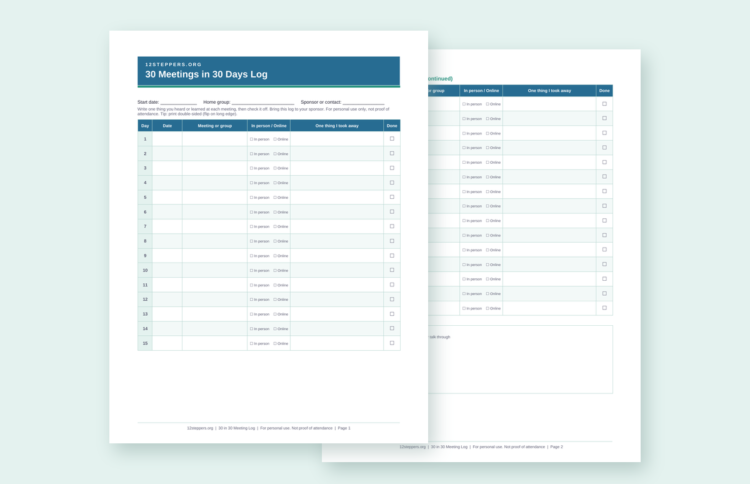
Ninety days can feel like a lot when you’re just starting out. Instead, commit to 1 meeting/day for 30 days. The 30 in 30 log gives each meeting its own row, with one thing you took away and a box for questions to bring to your sponsor.
Both trackers are for your own motivation. They aren’t proof of attendance. If a court, employer or program needs signatures, use our AA meeting attendance sheet instead but be sure to get their approval to use it from them and check their requirements first.
What Does 90 in 90 Mean?
“90 in 90” means going to 90 12 step meetings during your first 90 days. You’ll also hear it called “90 and 90” or “90 for 90.” In practice, it means a meeting a day for about three months.
It’s usually suggested to people who are brand new, coming out of treatment or starting over after a relapse. The idea is to surround early recovery with as much support as possible while everything feels unfamiliar.
Is 90 in 90 an AA Rule?
No. You won’t find 90 in 90 in the Big Book or AA’s other core literature, and it isn’t a condition of membership. AA’s Third Tradition is simple: “The only requirement for A.A. membership is a desire to stop drinking” (An Introduction to Our Twelve Traditions).
Its exact origin is unclear. Many members associate it with treatment programs, and some call it “treatment talk.” Plenty of others, including sponsors and old-timers, suggest it because it helped them. Think of it as a strong suggestion that works for a lot of people, not a test you can fail.
Why Newcomers Try 90 in 90
You meet people fast. Seeing the same faces every day turns strangers into a phone list. That matters on the nights when you need to call someone instead of picking up.
It replaces an old routine. A lot of the day used to revolve around drinking or using. A meeting gives that time a new place to go.
You find the meetings that fit. Ninety meetings is enough to try speaker, discussion, Big Book and step meetings at different times. Most people find a home group along the way.
You find a sponsor. Hearing people share every day makes it easier to spot someone whose recovery you want. Our guide to a sponsor’s role in 12 step programs explains what to look for.
One honest caution: meetings work best as part of the program, not instead of it.
A small study of 55 people after treatment found that some who attended plenty of meetings but held back from other parts of AA, like the literature and connecting with members, relapsed more often (Caldwell and Cutter, 1998).
The meeting gets you in the door. Getting involved, with a sponsor, the steps, the literature and the people in the room, is what helps you stay.
How to Make 90 in 90 Fit a Real Schedule
Plan the week ahead. Pick each day’s meeting on Sunday and write it on your tracker. Choose a backup for each day too. Use our guide to finding AA meetings near you to build your list.
Mix the times. Morning, noon and late meetings make it easier to work around a job or kids. A lunch-hour meeting near work can save a whole day.
Use online meetings. AA notes that “Online and telephone meetings are also available” (What to Expect at an A.A. Meeting). They’re a real help when transportation, weather or childcare gets in the way. Our list of online and virtual 12 step meetings has options for every fellowship.
Double up if you need to. If a 24-hour shift or a sick day knocks out a meeting, many people make it up with two meetings on another day. Talk it over with your sponsor if you’re unsure.
Ask for a ride. If you don’t drive, say so at a meeting. Members often offer rides, and it’s an easy way to get to know someone.
Avoiding 90 in 90 Burnout
Around the third or fourth week, a lot of people hit a wall. The meetings start to sound the same, and the drive feels long. That’s normal.
Change it up. Try a new format, a different neighborhood or a meeting for a group you identify with. Fresh voices help.
Show up early and stay late. Setting up chairs or making coffee turns watching into belonging. The worksheet for Step 12 has more service ideas for every stage.
Keep perspective. If you miss a day, you haven’t failed. Habit research suggests a single missed day “had little impact” on building a new habit (BPS Research Digest). Pick up again tomorrow.
Why 30 in 30 Is a Good First Goal
A shorter goal is easier to say yes to. Thirty days gets you through the first month, often the shakiest stretch, and it builds the same meeting habit. When you reach day 30, you can decide whether to keep going toward 90 with a lot more confidence.
Writing down one thing you heard at each meeting helps too. It gives you something to talk about with your sponsor, and over a month it becomes a record of what’s helping. If you finish your 30 and want to keep going, just pick up the 90 in 90 tracker at day 31.
What Comes After 90 Days
Many groups celebrate 90 days sober with a chip, coin or keytag, but customs vary. AA itself doesn’t make them: “Neither GSO nor A.A. produces, distributes or sells chips, coins, medallions or any other sobriety tokens,” and how groups celebrate is “a matter of local choice” (AA FAQ).
After 90 days, most people settle into a regular schedule built around a home group. In AA’s 2022 membership survey of more than 6,000 members, “Members attend an average of 2 A.A. meetings per week” (A.A. Membership Survey). Decide your own number with your sponsor, and lean on extra meetings when life gets hard.
If you haven’t started the steps yet, now is a good time. Our free 12 step worksheets walk you through each one.
90 in 90 FAQs
Do online meetings count toward 90 in 90?
For your own goal, yes. Many people mix in-person and online meetings. If a court or program is counting, ask them first, since some only accept in-person meetings.
What if I miss a day?
Go to a meeting the next day, or go to two. Missing one day doesn’t undo the progress you’ve made. If you keep missing days, talk with your sponsor about what’s getting in the way.
How long do AA meetings last?
AA doesn’t set a standard length. Each group decides, and meeting listings usually show the start and end time. Check the listing before you go so you can plan around it.
Does it really take 90 days to form a habit?
Not exactly. A well-known study from University College London found it took participants an average of 66 days to make a new behavior automatic, with a range from 18 to an estimated 254 days (BPS Research Digest). Ninety days is a reasonable target, not a magic number.
How many AA meetings should I go to a week after 90 days?
There’s no rule. AA’s 2022 survey found members attend an average of two meetings a week. Many newer members go more often, so work out a number with your sponsor.
Is this tracker proof of attendance?
No. It’s for your own motivation. If you need signatures for a court, employer or program, use our printable AA sign-in sheet and confirm their requirements first.
Additional Resources
- Alcoholics Anonymous World Services. “An Introduction to Our Twelve Traditions.” Alcoholics Anonymous.
- Alcoholics Anonymous World Services. “A.A. Membership Survey (2022).” Alcoholics Anonymous.
- Alcoholics Anonymous World Services. “What to Expect at an A.A. Meeting.” Alcoholics Anonymous.
- Alcoholics Anonymous World Services. “I Want to Buy Chips, Coins or Medallions. Are They Available From AA.org?” Alcoholics Anonymous.
- Caldwell, P. E. and H. S. Cutter. “Alcoholics Anonymous Affiliation During Early Recovery.” Journal of Substance Abuse Treatment.
- The British Psychological Society. “How to Form a Habit.” BPS Research Digest.
12steppers.org is an independent resource and is not affiliated with Alcoholics Anonymous, Narcotics Anonymous or any other fellowship. These trackers are for personal use and are not proof of attendance. This page is not medical advice.