Home » 12 Step Programs » 12-Step Worksheet with Questions – A Guide to Working the 12 Steps » Step 9 Worksheet With Questions – A Free Guide to Making Amends
Step 9 Worksheet With Questions - A Free Guide to Making Amends
A guided 9th step worksheet for AA, NA, Al-Anon and other 12 step programs
Your Step 8 list is finished. Now comes the part most people dread: actually talking to the people on it. This Step 9 worksheet helps you plan each amends with your sponsor, check your motives and figure out what to do when a face-to-face conversation would cause more harm than good.
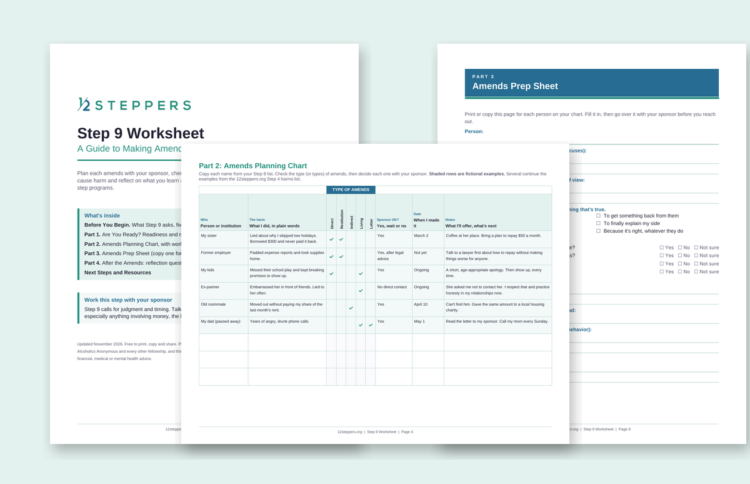
Download the Free Step 9 Worksheet (PDF and Word)
The worksheet walks you through Step 9 from start to finish. It includes readiness questions, an amends planning chart with worked examples, a one-page prep sheet you can print for each person and reflection questions for after each conversation. Print the PDF if you like working with a pen. The Word version lets you add rows to the chart and keep your notes private on your own device.
Step 9: "Made direct amends to such people wherever possible, except when to do so would injure them or others."
What Step 9 Asks of You
In Step 8, you made a list of the people you harmed and became willing to set things right. Step 9 is where you do it. The Big Book opens its discussion of this step bluntly: “Now we need more action, without which we find that ‘Faith without works is dead'” (Alcoholics Anonymous, p. 76).
An amends isn’t the same as an apology. An apology says “I’m sorry.” An amends says “I was wrong, here’s what I did and here’s how I’m going to make it right.”
Sometimes that means paying money back. Sometimes it means showing up, year after year, as a different person. The Big Book puts it plainly: “A remorseful mumbling that we are sorry won’t fill the bill at all” (p. 83).
The step also asks for wisdom. The Twelve Steps and Twelve Traditions says this step calls for good judgment and “a careful sense of timing,” along with courage and prudence (Step Nine, p. 83). That’s why nobody works it alone. Your sponsor helps you decide who, when and how.
For a deeper look at the step itself, read our guide to Step 9 and the 9th Step promises.
Step 9 Questions
These questions are built into the worksheet, with room to write. Many of them were refined from the original version of this worksheet, so long-time users will recognize them.
Before you begin
- Have you already tried to make amends to anyone? What did you do, and what did you learn from it?
- Why do you want to make these amends? Be honest about any hidden motives, such as wanting to be forgiven, liked again or proven right.
- Are you still angry at anyone on your list? If so, write them a letter saying everything you feel, then don’t send it. Talk it over with your sponsor instead.
- Who on your list are you most afraid to face? What’s the worst thing you imagine happening, and how likely is it really?
- Is your recovery steady enough right now to handle a hard conversation? What support will you line up before and after?
Planning each amends
- What exactly did you do to this person? Write it in plain words, without explaining why.
- What would actually help repair the harm, from their point of view rather than yours?
- Would contacting this person hurt them or anyone else, or expose someone else’s private business? What does your sponsor think?
- Does this amends involve money, the law or your job? Who should you get advice from before you act?
- If a direct conversation isn’t the right choice here, what will you do instead?
- Have you practiced this amends out loud with your sponsor, including how you’ll respond if it goes badly?
After each amends
- What happened? What did the other person say or do?
- Did you feel the urge to defend yourself or bring up what they did to you? What did you do with that urge?
- What did you learn that will make the next amends go better?
- Has anyone new come to mind who belongs on your list?
Direct, Indirect and Living Amends
Not every amends looks the same. The 12&12 sorts the people on our lists into a few rough groups: those we should approach as soon as we’re reasonably confident, those to whom we can make “only partial restitution,” cases where action “ought to be deferred” and people we’ll never be able to contact at all (Step Nine, p. 83).
That leads to several kinds of amends, and most lists use more than one.
| Type of amends | What it looks like | When it fits |
| Direct amends | Meeting in person when you can, or reaching out by phone or letter when you can’t | The default whenever contact won’t cause harm |
| Restitution | Repaying what you owe or making good on what you broke or took, even in small installments | When the harm has a cost you can repay, fully or in part |
| Indirect amends | Giving the amount you owe to a cause the person would value, or doing something useful in their honor | When the person can’t be found or contacted |
| Living amends | Lasting changes in how you treat people, practiced day after day | When direct contact would hurt someone, or alongside a direct amends to show you mean it |
| An unsent letter | Writing out everything you’d say, then reading it to your sponsor | When the person has died or contact would do harm |
Living amends get misunderstood. They aren’t a way to skip the hard conversations. They’re how you prove the words were true. As the Big Book says, “Our behavior will convince them more than our words” (p. 83).
When Amends Would Injure Them or Others
Step 9 has a built-in limit: we make direct amends “except when to do so would injure them or others.” It’s worth reading that carefully. The exception is about harm to other people. It isn’t about our embarrassment, our fear or how awkward the conversation will feel.
Those are reasons to pray and call your sponsor, not reasons to skip someone.
At the same time, the 12&12 warns that “we cannot buy our own peace of mind at the expense of others” (Step Nine, p. 84). Confessing an affair to ease your conscience, for example, can wound your partner and expose another person too.
The Big Book adds that before taking action that “might implicate other people we secure their consent” (p. 80).
Cases to bring to your sponsor first
- Secrets that involve someone else. If telling the truth would expose or hurt a third person, the amends usually changes shape.
- Money, crimes and jobs. The Big Book discusses creditors and criminal matters directly (pp. 78 to 79) and cautions against being “the hasty and foolish martyr” who sacrifices others. Get legal or financial advice before you act, and think about your family.
- People who’ve asked you not to contact them. Respect that. Make living amends instead. If there’s a protective or no-contact order, never contact the person.
- People who harmed you. You may owe an amends for your part, but you never owe anyone access to you. If contact could put you at risk, it isn’t required. Talk it through with your sponsor and, if needed, a licensed counselor.
If you ever feel unsafe or overwhelmed while working this step, pause and reach out. In the U.S., you can call or text the 988 Suicide and Crisis Lifeline any time.
How to Make an Amends
Most amends follow a similar shape. Start with the people who feel most manageable. Each one you complete makes the harder ones a little less frightening.
Prepare with your sponsor. Fill out a prep sheet for the person, decide what you’ll say and what you’ll offer and practice it out loud. When you reach out, keep it simple: “Would you be open to meeting for coffee this week? There’s something I’ve wanted to make right with you.”
Own your part, and only your part. Say exactly what you did, in simple terms. Leave out the reasons, the excuses and anything they did to you. The Big Book is clear on this: “Under no condition do we criticize such a person or argue” (p. 77). You’re there “to sweep off our side of the street.”
Ask what would make it right. Then listen. They may name something you didn’t expect. Do what you reasonably can, and if it involves money, agree on a plan you can keep.
Leave the response to them. Some people forgive on the spot. Some stay angry, and some never answer at all. None of that changes whether your amends was honest. Afterward, call your sponsor and write down what happened on the worksheet’s reflection page.
Example Step 9 Amends Plan
Here’s what a filled-in amends planning chart can look like. The entries are fictional, and several carry over from the examples in our Step 4 harms done to others worksheet, so you can follow one person’s list from inventory to amends.
| Person | The harm I did | Type of amends | Sponsor OK? | Date made | Notes |
| My sister | Lied about why I skipped two holidays. Borrowed $300 and never paid it back. | Direct, restitution | Yes | March 2 | Coffee at her place. Bring a plan to repay $50 a month. |
| Former employer | Padded expense reports and took supplies home. | Direct, restitution | Yes, after legal advice | Not yet | Talk to a lawyer first about how to repay without making things worse for anyone. |
| My kids | Missed their school play and kept breaking promises to show up. | Direct, living | Yes | Ongoing | A short, age-appropriate apology. Then show up, every time. |
| Ex-partner | Embarrassed her in front of friends. Lied to her often. | Living | No direct contact | Ongoing | She asked me not to contact her. I respect that and practice honesty in my relationships now. |
| Old roommate | Moved out without paying my share of the last month’s rent. | Indirect | Yes | April 10 | Can’t find him. Gave the same amount to a local housing charity. |
| My dad (passed away) | Years of angry, drunk phone calls. | Unsent letter, living | Yes | May 1 | Read the letter to my sponsor. Call my mom every Sunday. |
Notice that two people on this list won’t get a face-to-face conversation, and that’s fine. The ex-partner asked for no contact, so the amends is a changed life. The employer amends is on hold until there’s legal advice. Neither one is skipped. They’ve just taken a different shape.
Step 9 in NA, Al-Anon and Other Fellowships
This worksheet works across fellowships. Narcotics Anonymous uses the same wording, beginning with “We made direct amends” (NA, How It Works). Al-Anon’s Step Nine matches AA’s word for word.
In Al-Anon and other family programs, amends often go to the people closest to us, sometimes including the drinker or user. That might mean owning years of nagging, snooping, controlling or punishing silence. Making amends for your behavior doesn’t excuse theirs. You’re cleaning up your side, not taking responsibility for their choices.
The Ninth Step Promises
Right after its Step 9 instructions, the Big Book offers a passage members call the Ninth Step Promises. It begins, “If we are painstaking about this phase of our development, we will be amazed before we are half way through” (pp. 83 to 84). It goes on to describe a new freedom, less fear and a changed outlook on life.
Notice the condition at the start: if we are painstaking. The promises aren’t a reward for finishing a checklist. Many members say they show up gradually as each honest amends is made. You can read more in our guide to the Promises and what they mean.
Step 9 Worksheet FAQs
Do I have to make amends to everyone on my list?
You make amends wherever possible, except when doing so would injure the person or someone else. Some people get a direct conversation, some get restitution or a living amends and some can only get an unsent letter. Nobody is simply skipped. Work out with your sponsor which approach fits each name.
What’s the difference between an apology and an amends?
An apology expresses regret. An amends goes further: you own the specific harm, skip the excuses and offer to repair it. Then you back it up with changed behavior. Many people find the follow-through matters far more to the other person than the conversation itself.
What if the person won’t talk to me?
Respect their choice. You can’t force an amends on anyone, and trying would cause new harm. Make a living amends instead by changing the behavior that hurt them. If they ever reach out later, be ready to make a direct amends then.
What if the person has died?
Many members write a letter to that person saying everything they would have said, then read it to their sponsor. Some also make a living amends, such as caring for the family members left behind or supporting a cause the person valued.
Do I have to tell someone things they don’t know?
Not if telling them would hurt them or someone else. The 12&12 warns against buying our own peace of mind at another person’s expense. Talk any secret through with your sponsor before deciding. Often the right amends is a changed way of living rather than a confession.
What if making amends could get me in legal or financial trouble?
Slow down and get qualified advice from a lawyer or financial professional before you act, and talk it through with your sponsor. The Big Book discusses these situations and stresses thinking about how your choices affect your family and others. Willingness matters; recklessness doesn’t.
Can I use this as a Steps 8 and 9 worksheet?
Yes. The amends planning chart starts with your Step 8 list, so many people fill in the names and harms as part of Step 8, then complete the rest as they work Step 9. The Step 8 worksheet helps you build the list first.
How long does Step 9 take?
There’s no set timeline. Some amends happen within weeks, others take months and living amends never really end. The Big Book says there may be valid reasons to postpone some amends, but warns against delaying when it can be avoided (p. 83). Steady progress with your sponsor usually works best.
Additional Resources
- Alcoholics Anonymous World Services. “Chapter 6: Into Action.” Alcoholics Anonymous, Fourth Edition.
- Alcoholics Anonymous World Services. “Step Nine.” Twelve Steps and Twelve Traditions.
- Alcoholics Anonymous World Services. “The Twelve Steps.” Alcoholics Anonymous.
- Narcotics Anonymous World Services. “How It Works.” Narcotics Anonymous.
- Al-Anon Family Groups. “The Twelve Steps.” Al-Anon Family Groups.
- 988 Suicide and Crisis Lifeline. “988 Lifeline.” 988 Suicide and Crisis Lifeline.
12steppers.org is an independent resource and is not affiliated with Alcoholics Anonymous, Narcotics Anonymous, Al-Anon or any other fellowship. This worksheet is a recovery tool, not legal, financial, medical or mental health advice.
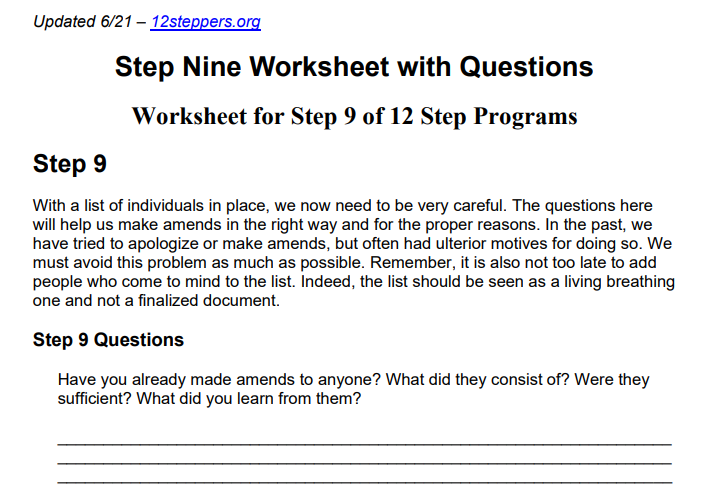
Previous Step 9 Worksheet Version
Some people and groups still prefer the original question-based format of this worksheet. You can still download the previous version below.