
Home » 12 Step Programs » 12-Step Worksheet with Questions – A Guide to Working the 12 Steps » Step 11 Worksheet With Questions – A Daily Prayer and Meditation Guide
Step 11 Worksheet With Questions - A Daily Prayer and Meditation Guide
A guided 11th step worksheet for AA, NA, Al-Anon and every other 12 step program
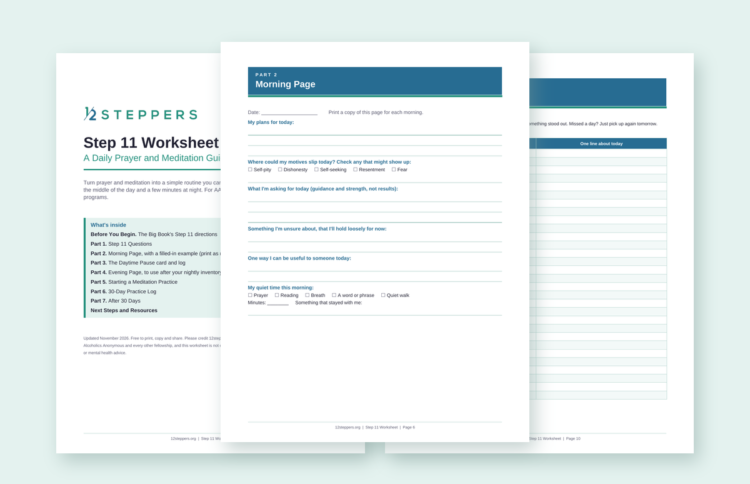
Step 10 keeps your side of the street clean. Step 11 keeps you connected to whatever gives you the strength to do it. This Step 11 worksheet turns “prayer and meditation” into a simple routine you can actually keep, with a page for the morning, a pause for the middle of the day and a few minutes at night.
Download the Free Step 11 Worksheet (PDF and Word)
The worksheet follows the Big Book’s own Step 11 directions. It includes reflection questions, a reusable morning page, a pocket-sized daytime pause, an evening page that picks up where your nightly inventory leaves off, a meditation starter plan and a 30-day practice log to review with your sponsor.
Print the PDF if you like a pen and paper routine. The Word version lets you type your answers and keep them private on your own device.
Step 11: "Sought through prayer and meditation to improve our conscious contact with God as we understood Him, praying only for knowledge of His will for us and the power to carry that out."
What Step 11 Asks of You
Step 11 has two parts. The first is a practice: prayer and meditation, done regularly. The second is a request: asking only to know what you should do and for the strength to do it. Notice what the step leaves out. It doesn’t ask you to pray for a new job, a better marriage or a winning lottery ticket.
The phrase “God as we understood Him” matters here too. The Big Book says, “Much to our relief, we discovered we did not need to consider another’s conception of God” (Alcoholics Anonymous, p. 46). Your Higher Power can be God, the group, nature or something you’re still figuring out.
For the meaning behind the step, the 11th step prayer and how to start praying if you never have, read our guide to Step 11 and prayer and meditation. This page is the hands-on companion.
Step 11 Questions
These questions open the worksheet, with room to write. Long-time users will recognize several of them from the original version, reworded so they fit believers, agnostics and everyone in between.
Your Higher Power
- How has my belief in a Higher Power changed since I started working the steps?
- How would I describe my Higher Power, or my spiritual practice, in my own words?
- What does spirituality mean to me, and how is it different from religion? Do I need both?
Prayer
- How often do I pray, and how do I usually feel afterward?
- When I pray, am I asking for guidance or placing an order? Do I give thanks? Do I pray for other people?
Meditation
- Do I meditate? If not, what’s stopping me? If I do, what happens when I sit quietly?
- When I’m still, do I feel connected to anything? What am I listening for?
Living it
- How has my relationship with a Higher Power changed the way I see myself?
- How do I remind myself during the day that I’m not in control?
- Which spiritual habits have lasted for me in the past, and which ones faded? Why?
- What is one practice I’m willing to keep every day for the next 30 days?
The Big Book’s Step 11 Directions – Night, Morning and Day
“Step Eleven suggests prayer and meditation,” the Big Book says (p. 85), and then it does something many people miss. It gives specific directions for three times of day. The worksheet is built around them.
| When | What the Big Book suggests | Page | Worksheet section |
| At night | Review the day constructively, then ask for forgiveness and what corrective measures to take | 86 | Part 4, Evening |
| On awakening | Think about the day ahead, ask for direction and check your motives | 86 | Part 2, Morning Page |
| When undecided | Ask for inspiration, an intuitive thought or a decision, then relax and don’t force it | 86 | Part 2, Morning Page |
| Throughout the day | Pause when agitated or doubtful and ask for the right thought or action | 87 to 88 | Part 3, Daytime Pause |
Notice that the directions start at night, not in the morning. That’s one reason so many members think of Steps 10 and 11 as a pair, which we cover below.
On Awakening – Planning Your Day (With an Example)
The Big Book’s morning direction is short: “On awakening let us think about the twenty-four hours ahead” (p. 86). You look at your plans, then ask for your thinking to be “divorced from self-pity, dishonest or self-seeking motives” (p. 86).
In plain terms, you’re asking two questions. What’s on my plate today? Where am I likely to get in my own way? The morning page in the worksheet walks you through both, plus one more that keeps Step 11 pointed outward: how can I be useful today?
Here’s what one fictional morning page might look like:
| Morning question | My answer |
| My plans for today | Work until 5. Pick up my son at 5:30. Home group at 7. |
| Where my motives could slip | I want to look good in the budget meeting more than I want to be useful. Still sore about my sister’s text last night. |
| What I’m asking for | Help to be honest in the meeting and patient with my sister. |
| Something I’m unsure about | Whether to take the extra shift Saturday. I won’t decide in a rush. I’ll sit with it and talk it over with my sponsor. |
| One way I can be useful today | Text the newcomer from Tuesday’s meeting. Let my coworker present her part without jumping in. |
| My quiet time | Ten minutes with coffee before anyone else is up. Read one page, then sit with it. |
It takes about five minutes. Notice the line about Saturday’s shift. The Big Book suggests that when we can’t decide, we ask for “inspiration, an intuitive thought or a decision” and then, “We relax and take it easy. We don’t struggle” (p. 86). Not every question needs an answer before breakfast.
Some members like to open the morning with a few lines of thanks, too. Our free printable gratitude worksheet pairs well with this page.
During the Day – Pause When Agitated or Doubtful
Mornings are easy compared with 2:30 in the afternoon. The Big Book’s answer is simple: “As we go through the day we pause, when agitated or doubtful, and ask for the right thought or action” (p. 87). It adds the habit of “humbly saying to ourselves many times each day ‘Thy will be done'” (p. 88).
If you have a Step 10 spot-check habit, this will feel familiar. The spot-check asks what’s wrong. The Step 11 pause asks for help with what to do next. A simple version:
Stop. Step away from the screen, the conversation or the car horn for a moment.
Breathe. Take three slow breaths. It sounds too simple to matter, and it often helps anyway.
Ask. Ask for the next right thought or action, in whatever words fit you. “Thy will be done” “Show me the next right thing” or just “Help.”
Return. Go back to what you were doing and do the next small thing well.
The worksheet’s daytime pause page is sized to cut out and keep in a wallet or snap a photo of for your phone.
Steps 10 and 11 Together – The Evening Review
If you’ve looked for an AA step 10 and 11 worksheet, here’s why the two get paired. The famous nightly review, “When we retire at night, we constructively review our day” (p. 86), sits inside the Big Book’s Step 11 directions. Step 10 keeps an eye on your behavior. Step 11 gives that review a spiritual finish.
After the review, the Big Book says “we ask God’s forgiveness and inquire what corrective measures should be taken” (p. 86). That second half is what the evening page in this worksheet is for. It asks whether you finished your inventory, what you’ll set right tomorrow and how you’ll close the day in prayer or quiet.
For the inventory itself, use the nightly section of our Step 10 worksheet with questions, or print the one-page AA nightly inventory PDF. Do that first, then turn to the evening page here. Together they take about ten minutes.
Meditation for Beginners
Plenty of people stall on Step 11 because they think they’re bad at meditation. The Twelve Steps and Twelve Traditions takes the pressure off. It calls meditation “essentially an individual adventure” and says, “Meditation is something which can always be further developed” (Step Eleven, p. 101). In other words, nobody starts out good at it.
Here are four easy ways to begin. Pick one and stick with it for a week before you judge it.
Read and reflect. Read a short passage of program literature, a prayer or a daily reader slowly. Stop on the line that catches you and stay with it for a few minutes. The 12&12 itself models this, walking “beginners in meditation” through a single prayer line by line (p. 99).
Count your breaths. Sit comfortably and count each exhale from one to ten, then start again. When you lose count, begin again at one.
Repeat a word or phrase. Choose something short that means something to you, like “Thy will be done,” “peace” or “one day at a time.” Repeat it quietly as you breathe.
Take a quiet walk. Leave the phone and the earbuds behind. Notice what you see and hear for ten minutes without trying to solve anything.
Start with five minutes. When your mind wanders (and it will, constantly), notice it and come back. That return is the practice, not a sign you’re doing it wrong.
The National Center for Complementary and Integrative Health says meditation and mindfulness “usually are considered to have few risks,” but meditation isn’t a substitute for medical or mental health care. If quiet time stirs up distressing memories or feelings, talk with a health care provider as well as your sponsor.
Praying for Guidance Instead of Results
“Praying only for knowledge of His will for us and the power to carry that out” is the hardest phrase in the step for most people.
The Big Book says, “We ask especially for freedom from self-will” and “We are careful never to pray for our own selfish ends” (p. 87). The 12&12 warns about prayers where “we are asking God to do it our way” (p. 102).
That doesn’t mean you can’t bring real worries to your Higher Power. It means changing the shape of the request. A few examples:
| Instead of | Try |
| “Please let me get this job.” | “Help me prepare well, be honest in the interview and accept what comes.” |
| “Make my son stop using.” | “Show me how to love him without trying to control him.” |
| “Make her see she was wrong.” | “Help me see my part and let go of the rest.” |
| “Fix my money problems.” | “Give me the courage to open the bills today and make a plan.” |
The worksheet’s prayer questions ask you to notice which kind of prayer you tend to say. Our Step 11 guide goes deeper on why bargaining with a Higher Power rarely brings peace.
Step 11 for Agnostics, Atheists and Everyone in Between
If the word “God” makes you tense up, you’re not the first. The Big Book’s chapter “We Agnostics” was written for exactly that reader, and it says “God does not make too hard terms with those who seek Him” (p. 46).
AA’s pamphlet The “God” Word: Agnostic and Atheist Members in A.A. shares members’ stories and says “there is room in the Fellowship for believers and non-believers alike.” One member describes their higher power as “the love and wisdom I find in the rooms of A.A.” (p. 13).
For nonbelievers, Step 11 often looks like quiet reflection, breath meditation or a daily reading, plus the question “What’s the next right thing?” Some members address the group or their own best values instead of a deity. The worksheet uses “Higher Power” throughout and leaves the definition to you, so it works either way.
Step 11 in NA, Al-Anon and Other Fellowships
The wording barely changes from one fellowship to the next. Narcotics Anonymous adds one word at the start: “We sought through prayer and meditation to improve our conscious contact with God as we understood Him” (NA, How It Works). Al-Anon’s Step Eleven matches AA’s word for word.
In Al-Anon, the daytime pause often gets used most around a loved one’s choices, as a way to stop and ask for guidance before trying to fix or rescue. In Overeaters Anonymous, some members add their food plan to the morning page. Use whatever language fits your program.
Step 11 Worksheet FAQs
Is there an 11th step prayer?
Yes. The prayer most members mean is the one the 12&12 shares in its Step Eleven essay, written by a man the book describes as “rated as a saint” (p. 99). It’s widely known as the Prayer of St. Francis. You’ll find the full text on our Step 11 page.
Do I have to believe in God to work Step 11?
No. The step says “God as we understood Him,” and AA’s literature includes agnostic and atheist members. Many work Step 11 through meditation, reflection and connection with the group. What matters is the daily practice and the willingness to look for guidance beyond your own ego.
How long should I meditate?
There’s no required length. Five minutes a day is a realistic start, and many members slowly build to fifteen or twenty. A short practice you keep every day does more than a long one you skip.
Can I do Steps 10 and 11 at the same time?
Yes, and the Big Book’s directions actually combine them. Do your nightly inventory first, then use the evening page of this worksheet for prayer, meditation and deciding what to correct tomorrow.
What are the Joe and Charlie Step 11 worksheets?
Joe McQuany and Charlie Parmley led a well-known Big Book study for AA members starting in 1977, and their recorded talks still circulate (Stories of Recovery).
You’ll find handouts online labeled with their names, but we can’t confirm which came from them directly. This worksheet isn’t affiliated with their study, but it takes the same text-first approach, following the Big Book page by page.
What if I don’t feel anything when I pray or meditate?
That’s common, especially early on. Keep going anyway and track it on the 30-day log. Many members notice the change in their days before they notice it in the quiet time itself. The 12&12 points to “the sense of belonging that comes to us” as one of the greatest rewards (p. 105).
Where is Step 11 in the Big Book?
The step itself is listed with the other eleven on page 59, in the chapter “How It Works.” The directions for practicing it come later, on pages 85 to 88 of the chapter “Into Action”.
Additional Resources
- Alcoholics Anonymous World Services. “Chapter 6: Into Action.” Alcoholics Anonymous, Fourth Edition.
- Alcoholics Anonymous World Services. “Chapter 4: We Agnostics.” Alcoholics Anonymous, Fourth Edition.
- Alcoholics Anonymous World Services. “Step Eleven.” Twelve Steps and Twelve Traditions.
- Alcoholics Anonymous World Services. “The “God” Word: Agnostic and Atheist Members in A.A.” Alcoholics Anonymous.
- Narcotics Anonymous World Services. “How It Works.” Narcotics Anonymous.
- Al-Anon Family Groups. “The Twelve Steps.” Al-Anon Family Groups.
- National Center for Complementary and Integrative Health. “Meditation and Mindfulness: Effectiveness and Safety.” National Institutes of Health.
- Stories of Recovery. “Joe and Charlie Big Book Study.” Stories of Recovery.
12steppers.org is an independent resource and is not affiliated with Alcoholics Anonymous, Narcotics Anonymous, Al-Anon or any other fellowship. This worksheet is a recovery tool, not medical or mental health advice.
Previous Step 11 Worksheet Version
< Step 10 Worksheet | Step 12 Worksheet >