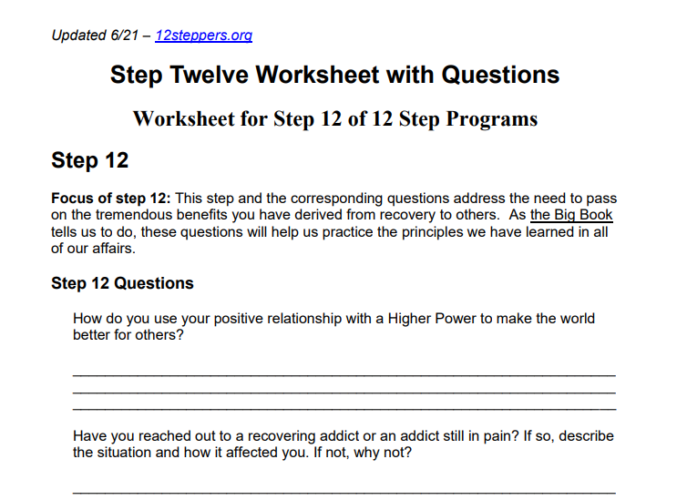
Home » 12 Step Programs » 12-Step Worksheet with Questions – A Guide to Working the 12 Steps » Step 12 Worksheet With Questions – Carrying the Message and Practicing the Principles
Step 12 Worksheet With Questions - Carrying the Message and Practicing the Principles
A guided 12th step worksheet for AA, NA, Al-Anon and every other 12 step program
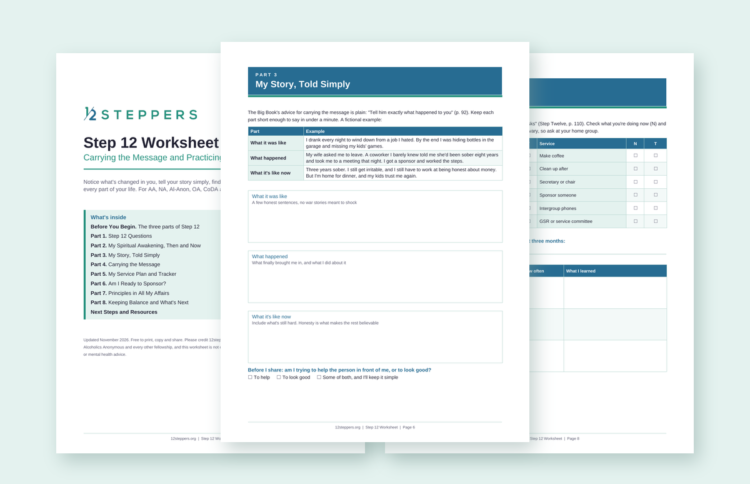
Step 12 is where everything you’ve worked on starts pointing outward. This Step 12 worksheet helps you notice what’s changed in you, tell your story simply, find service that fits where you are and bring the principles of the program home, to work and everywhere else.
Download the Free Step 12 Worksheet (PDF and Word)
The worksheet covers all three parts of the step. It includes Step 12 questions, a “then and now” page for your spiritual awakening, a story builder, a page for carrying the message, a service plan and tracker, a sponsorship self-check and a page for practicing the principles in daily life.
Print the PDF if you like working with a pen. The Word version lets you type your answers and keep them private on your own device.
Step 12: "Having had a spiritual awakening as the result of these steps, we tried to carry this message to alcoholics, and to practice these principles in all our affairs."
What Step 12 Asks of You
Step 12 packs three ideas into one sentence. Each one asks something different of you.
| Part of the step | What it asks | Worksheet section |
| “Having had a spiritual awakening” | Notice what’s changed in you because of the steps | Part 2 |
| “We tried to carry this message” | Share your experience with anyone still struggling, and do service | Parts 3 to 6 |
| “To practice these principles in all our affairs” | Live the program at work, at home and everywhere else, not just in meetings | Parts 7 and 8 |
Notice the word “tried.” Step 12 doesn’t ask you to save anyone. It asks you to make the effort and leave the results alone. For the meaning behind the step and the idea of attraction rather than promotion, read our guide to Step 12, carrying the message and practicing the principles.
Step 12 Questions
These questions open the worksheet, with room to write. Several come from the original version of this worksheet, reworded so they fit AA, NA, Al-Anon and other fellowships.
Your spiritual awakening
- What has changed in me since I started working the steps? What do I see differently now?
- Who in my life has noticed a change in me, and what did they say?
Carrying the message
- Have I reached out to someone who is still struggling? What happened, or what has held me back?
- What did I need most when I was new, and how can I offer that to someone else?
- When I share at meetings, am I trying to help the newcomer or impress the room?
Service and sponsorship
- What service am I doing now, and what could I add next?
- Do I feel ready to sponsor? What would I want to strengthen in my own program first?
In all our affairs
- How did I handle conflict before recovery, and how do I handle it now?
- What does “practice these principles in all our affairs” mean in my daily life?
- Which part of my life (work, home, money or relationships) is hardest to bring my program into?
- How am I protecting my own recovery while I help others?
Your Spiritual Awakening – Noticing What’s Changed
Many people get stuck on the first phrase of Step 12 because they’re waiting for a lightning bolt. The Big Book’s appendix on spiritual experience says sudden transformations, “though frequent, are by no means the rule.” Most are what psychologist William James called “the educational variety,” because “they develop slowly over a period of time” (Alcoholics Anonymous, p. 567).
The same page adds that “friends of the newcomer are aware of the difference long before he is himself” (p. 567). That’s why the worksheet asks who has noticed a change in you. Other people often see it first.
The “then and now” page in the worksheet makes the change concrete. You compare how you used to handle family, work, honesty, fear and faith with how you handle them today. Seeing it in writing can be surprising.
Telling Your Story Simply (With an Example)
Your story is the main thing you have to offer. The Big Book says its members’ stories describe “what we used to be like,” then what happened and what we’re like now (p. 58). In the “Working With Others” chapter, the advice is just as plain: “Tell him exactly what happened to you” (Alcoholics Anonymous, p. 92).
Here’s a fictional example of a two-minute version:
| Part of the story | Fictional example |
| What it was like | I drank every night to wind down from a job I hated. By the end I was hiding bottles in the garage and missing my kids’ games. |
| What happened | My wife asked me to leave. A coworker I barely knew told me she’d been sober eight years and took me to a meeting that night. I got a sponsor and worked the steps. |
| What it’s like now | Three years sober. I still get irritable, and I still have to work at being honest about money. But I’m home for dinner, and my kids trust me again. |
Notice what it leaves out. There are no war stories meant to shock, and no claim that life is perfect now. The “what it’s like now” part even admits what’s still hard. That honesty is what makes a newcomer believe the rest.
The story builder in the worksheet gives you a box for each part, then a check: are you sharing to help the person in front of you, or to look good?
Carrying the Message – What the Big Book Suggests
The Big Book’s chapter “Working With Others” opens with a strong claim: “Practical experience shows that nothing will so much insure immunity from drinking as intensive work with other alcoholics” (p. 89). A few pages later it calls helping others “the foundation stone of your recovery” (p. 96).
Research points the same way. In a study using Project MATCH data, 40 percent of alcoholics who helped other alcoholics avoided drinking in the year after treatment, compared with 22 percent of those who didn’t, according to Case Western Reserve University. That’s a link, not proof that helping causes sobriety, but it fits what members have said for decades.
The chapter also gives practical guidance that still holds up:
Share, don’t preach. “Never talk down to an alcoholic from any moral or spiritual hilltop” (p. 94). Your experience carries more weight than advice.
Don’t push. If someone isn’t interested, the Big Book says “you may have to drop him until he changes his mind” (p. 94). Leaving the door open is enough.
Be patient. “Do not be discouraged if your prospect does not respond at once” (p. 95). Many people come back months or years later.
Point to the program, not to yourself. The Big Book urges members to “burn the idea into the consciousness of every man that he can get well regardless of anyone” (p. 97). You’re a messenger, not the solution.
A Twelfth Step call is the traditional name for reaching out to someone who has asked for help, whether in person or by phone. Many members suggest going with another sober member and talking it over with your sponsor first. The worksheet has a page for planning one.
Ways to Be of Service at Any Stage
Service doesn’t wait until you’ve finished the steps. The Twelve Steps and Twelve Traditions praises “the unspectacular but important tasks,” including “arranging for the coffee and cake after the meetings” (Step Twelve, p. 110). Here are some options by stage:
| When | Service ideas |
| Any time, even early on | Set up chairs, make coffee, greet people at the door, help clean up, share your phone number with newcomers |
| Once you’re settled in a home group | Take a group commitment like literature, treasurer or secretary. Read at meetings or chair when asked |
| After working the steps | Sponsor someone, share your story as a speaker, go on Twelfth Step calls with another member |
| Wider service | Hospitals and institutions (H&I) or corrections meetings, public information, answering phones for your local intergroup, serving as a general service representative (GSR) |
Requirements for group and general service roles vary by group and area, so ask at your home group’s business meeting. The worksheet’s service plan helps you choose one commitment to start now and track it for three months.
Are You Ready to Sponsor?
Sponsoring someone is one of the most personal forms of Step 12 work. AA’s pamphlet Questions & Answers on Sponsorship says “There are no specific rules,” but suggests “a good sponsor should probably be a year or more away from the last drink” (p. 8).
The same pamphlet sets some healthy limits. “An A.A. sponsor does not offer professional services” (p. 13), and a sponsor “should not act like a professional counselor” (p. 15). Your job is to share your experience with the steps, not to fix someone’s life.
The worksheet’s sponsorship self-check asks whether you’ve worked all twelve steps, whether you still have a sponsor of your own, how much time you can honestly give and what you’ll do when someone relapses. Go over it with your sponsor. For more on what the role involves, read our guide to a sponsor’s role in 12 step programs.
Practicing These Principles in All Our Affairs
The last phrase of Step 12 is easy to skip. The 12&12 asks it directly: “Can we actually carry the A.A. spirit into our daily work?” (p. 112). It asks the same about family life.
Each step is commonly paired with a spiritual principle, from honesty in Step 1 to service in Step 12. This list comes from member tradition rather than AA’s official literature. Read what each one means on our page about the 12 spiritual principles of AA.
Here’s how a few of them might look in everyday life:
| Area of life | Principle | What it looks like |
| Work | Honesty | Give an accurate status update, even when it makes me look bad. |
| Home | Patience | Let my teenager finish talking before I respond. |
| Money | Integrity | Pay bills on time and stop hiding purchases. |
| Relationships | Humility | Apologize first, even when I think I’m mostly right. |
| Online | Love | Don’t post the angry reply I drafted at midnight. |
The principles page in the worksheet lists all twelve. You mark where each one is hardest for you and choose one small action for the week. Small and specific beats a vague promise to “be a better person.”
When Helping Turns Into Overdoing It
Service can go sideways. Three patterns come up often:
Rescuing. Paying someone’s rent, driving them everywhere or taking their relapse personally. The Big Book is clear that “It is not the matter of giving that is in question, but when and how to give” (p. 97). AA’s sponsorship pamphlet notes that a sponsor who lends money “does so at risk” (p. 16).
Burnout. Saying yes to every commitment until you resent all of them. If service is crowding out meetings, family or sleep, it’s time to hand something off.
Two-stepping. The 12&12 uses this name for jumping from Step 1 straight to Step 12, skipping the work in between (p. 113). Helping others is good. Using it to avoid your own inventory isn’t.
The worksheet’s balance check asks how many commitments you have, whether you still have a sponsor and a home group of your own and which steps you might want to revisit.
Step 12 in NA, Al-Anon and Other Fellowships
The main difference between fellowships is who receives the message. Narcotics Anonymous carries it “to addicts” (NA, How It Works). Al-Anon’s Step Twelve carries it “to others,” meaning the families and friends of alcoholics.
In Al-Anon, carrying the message often means sharing with a friend or relative who is living with someone’s drinking. Al-Anon members are carrying the message to families, not trying to sober up the drinker. In Overeaters Anonymous and other programs, the worksheet works the same way. Just use your fellowship’s language.
Step 12 Worksheet FAQs
Do I have to finish all the steps before doing service?
No. Setting up chairs, making coffee and greeting newcomers are open to anyone, and many members start in their first weeks. Sponsorship is different. Most people wait until they’ve worked all twelve steps.
What is a Twelfth Step call?
It’s reaching out to someone who has asked for help with their drinking or using, in person or by phone. You share your own experience, explain how the program works for you and leave the decision to them. Many members bring another sober member along.
How do I know if I’ve had a spiritual awakening?
For most people it’s gradual. The Big Book’s appendix describes realizing you’ve “undergone a profound alteration in [your] reaction to life” (p. 567). If you react differently to fear, resentment or other people than you used to, that’s a good sign. Ask the people close to you what they’ve noticed.
What are the 12 principles of AA?
The list most members use pairs each step with a principle: honesty, hope, faith, courage, integrity, willingness, humility, love, responsibility, discipline, awareness and service. Lists vary a little, since this pairing isn’t in AA’s official literature. See our full guide to the spiritual principles of the 12 steps.
What comes after Step 12?
Steps 10, 11 and 12 continue every day. Many members also work through all twelve steps again with their sponsor every few years. The worksheet’s last page asks which steps you might want to revisit.
What if someone I help relapses?
It isn’t your failure. You offered your experience, and their recovery belongs to them. Talk it over with your sponsor, keep the door open and remember the Big Book’s reminder not to be discouraged when someone “does not respond at once” (p. 95).
Additional Resources
- Alcoholics Anonymous World Services. “Chapter 7: Working With Others.” Alcoholics Anonymous, Fourth Edition.
- Alcoholics Anonymous World Services. “Chapter 5: How It Works.” Alcoholics Anonymous, Fourth Edition.
- Alcoholics Anonymous World Services. “Appendix II: Spiritual Experience.” Alcoholics Anonymous, Fourth Edition.
- Alcoholics Anonymous World Services. “Step Twelve.” Twelve Steps and Twelve Traditions.
- Alcoholics Anonymous World Services. “Questions & Answers on Sponsorship.” Alcoholics Anonymous.
- Narcotics Anonymous World Services. “How It Works.” Narcotics Anonymous.
- Al-Anon Family Groups. “The Twelve Steps.” Al-Anon Family Groups.
- Case Western Reserve University. “Helping Others Helps Alcoholics Stay on the Road to Recovery, Case Western Reserve Research Shows.” Case Western Reserve University News.
12steppers.org is an independent resource and is not affiliated with Alcoholics Anonymous, Narcotics Anonymous, Al-Anon or any other fellowship. This worksheet is a recovery tool, not medical or mental health advice.
Previous Step 12 Worksheet Version